
World Center for Strategic Studies
From closed analysis to public debate

- MONTH
- YEAR

Europe’s AI dream is slipping away: the EU is falling behind fast
This HCSS “Draghi Report Revisited” piece delivers a blunt reality check on European artificial intelligence. Brussels talks up innovation, “trustworthy AI” and digital sovereignty – but Europe is losing the race to the US and China, and it is not even close. The EU has talent and research, yet it lacks what matters most in AI: scale, capital, compute, and companies that can dominate globally. Europe’s AI problem is not hype – it’s structural weakness, and it is getting worse.
Europe has talent, but not the machine
Europe produces strong research and high-level talent, and it often punches above its weight in academic AI. But the piece makes clear that this does not translate into real power.
AI leadership depends on massive computing infrastructure, access to specialised chips, deep capital markets, and fast commercial deployment. Europe is short on all of them. It is trying to win a scale war with a small budget and a fragmented market.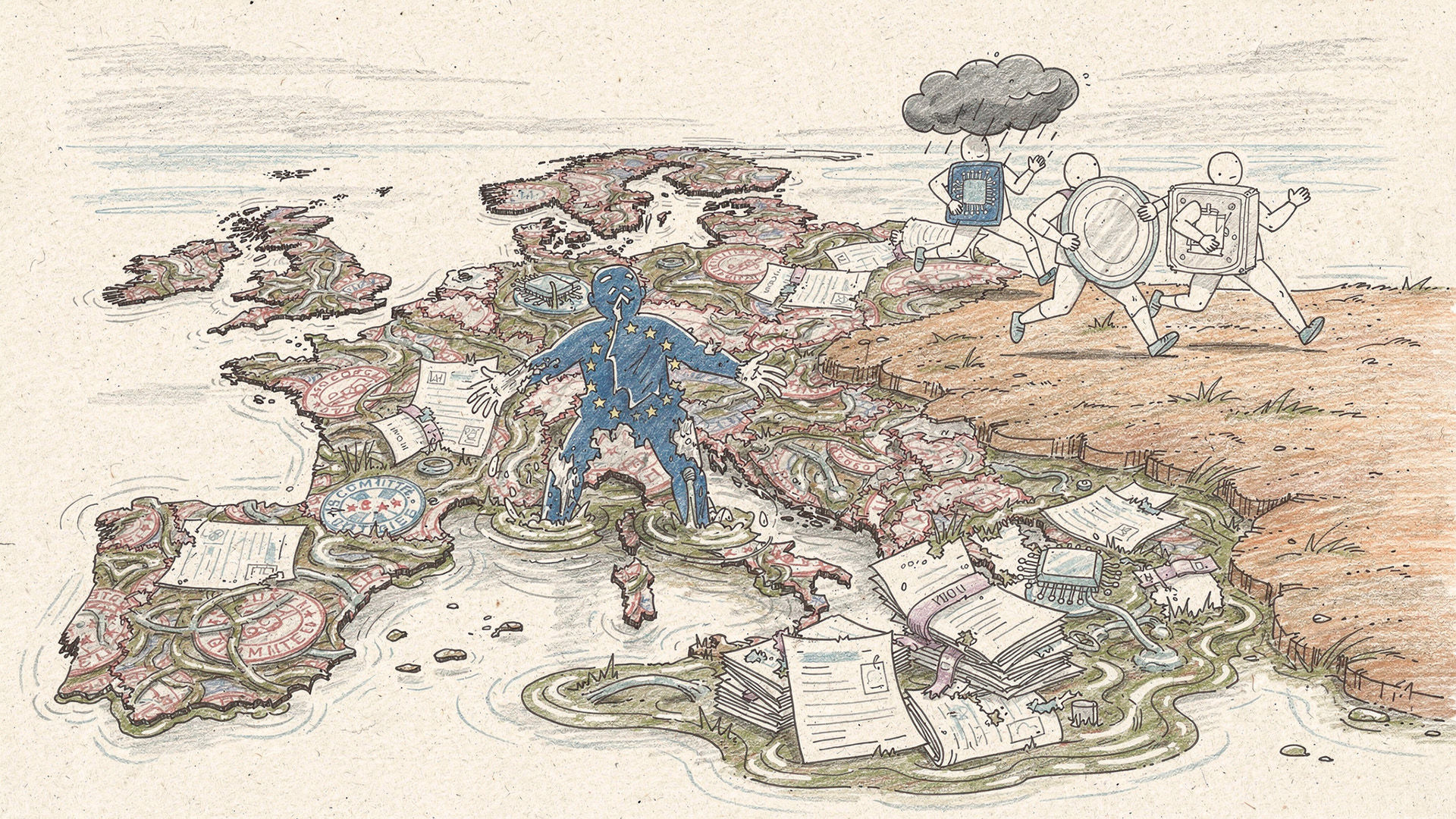

The US and China control the AI battlefield
Europe’s biggest headache is that the global AI stack is dominated by others. The US leads in frontier models, cloud platforms, venture capital and the biggest AI companies. China pushes AI through state support and industrial policy.
Europe, by comparison, is stuck in a defensive position – importing key technologies, relying on foreign cloud services, and watching top talent get pulled away by higher salaries and bigger projects abroad. Europe is not shaping the AI future – it is adapting to decisions made elsewhere.
Regulation first, competitiveness later
Brussels’ answer to AI has been heavy on rules. The EU AI Act is positioned as a global standard-setter, designed to make AI “safe” and “trustworthy”.
But HCSS underlines the risk: Europe may build the strictest rulebook on Earth while others build the technology. Over-regulation can slow deployment, raise compliance costs and make Europe a less attractive place to invest. The EU could end up with “ethical AI” – and no AI champions.
Europe can’t match the money
AI is an investment arms race. Europe’s funding ecosystem is weaker than Silicon Valley’s, and scale-up capital is harder to secure. European startups often hit a wall – and then relocate, get acquired, or simply lose.
This creates a familiar European pattern: Europe invents, others industrialise. It produces ideas, but struggles to produce giants.
Fragmentation is still killing speed
Europe’s single market does not behave like one market. Different languages, legal regimes, procurement rules and national priorities slow scaling.
In AI, speed matters – and Europe is structurally slow. Even good projects suffer from coordination problems, uneven implementation and fragmented demand.
Compute: Europe’s silent vulnerability
One of Europe’s biggest strategic problems is computing infrastructure. Training and deploying advanced AI models requires hyperscale data centres and cutting-edge chips. Europe remains dependent on non-European suppliers across the chain.
That makes “digital sovereignty” look more like a slogan than a strategy. In a future where compute equals power, Europe risks permanent dependency.
What Europe needs to do now
HCSS points to obvious priorities: invest heavily in compute, create real funding mechanisms for scale-ups, reduce fragmentation, and make regulation innovation-friendly rather than innovation-hostile. Europe also needs to keep talent at home with competitive opportunities, not just academic prestige.
But that requires a mindset shift. Europe cannot regulate its way into leadership. It has to build.
Bottom line
The EU wants to lead in AI, but it is not acting like a serious competitor. It has rules, committees and strategy documents – while others have chips, capital and global platforms.
Unless Europe moves faster and invests at scale, its AI future will be decided abroad – and Brussels will be left managing the consequences rather than shaping the technology.



.jpg?tr=cm-pad_resize,w-231)