World Center for Strategic Studies
From closed analysis to public debate

- MONTH
- YEAR

Europe’s undersea lifelines are wide open: the EU is scrambling to protect cables it can’t afford to lose
This EPC paper warns that Europe’s subsea infrastructure – the cables and pipelines that keep its internet, energy and economy running – is far more vulnerable than most Europeans realise. The EU has launched an action plan, but the analysis argues this is not enough. Threats are rising fast, from sabotage and espionage to accidents and geopolitical pressure. Meanwhile Europe’s response remains fragmented, slow and underpowered. The hard truth is that Europe depends on undersea networks it does not fully control and cannot reliably defend.
Europe’s weak spot sits under the sea
Subsea infrastructure sounds technical, but it is strategic. Europe relies on undersea cables for communications and data flows, and on pipelines and power links for energy security. The report stresses that if these systems are disrupted, the damage is immediate – economic chaos, disrupted services, political panic.
Europe has built a modern economy on invisible infrastructure, then failed to protect it at the level the threat now demands.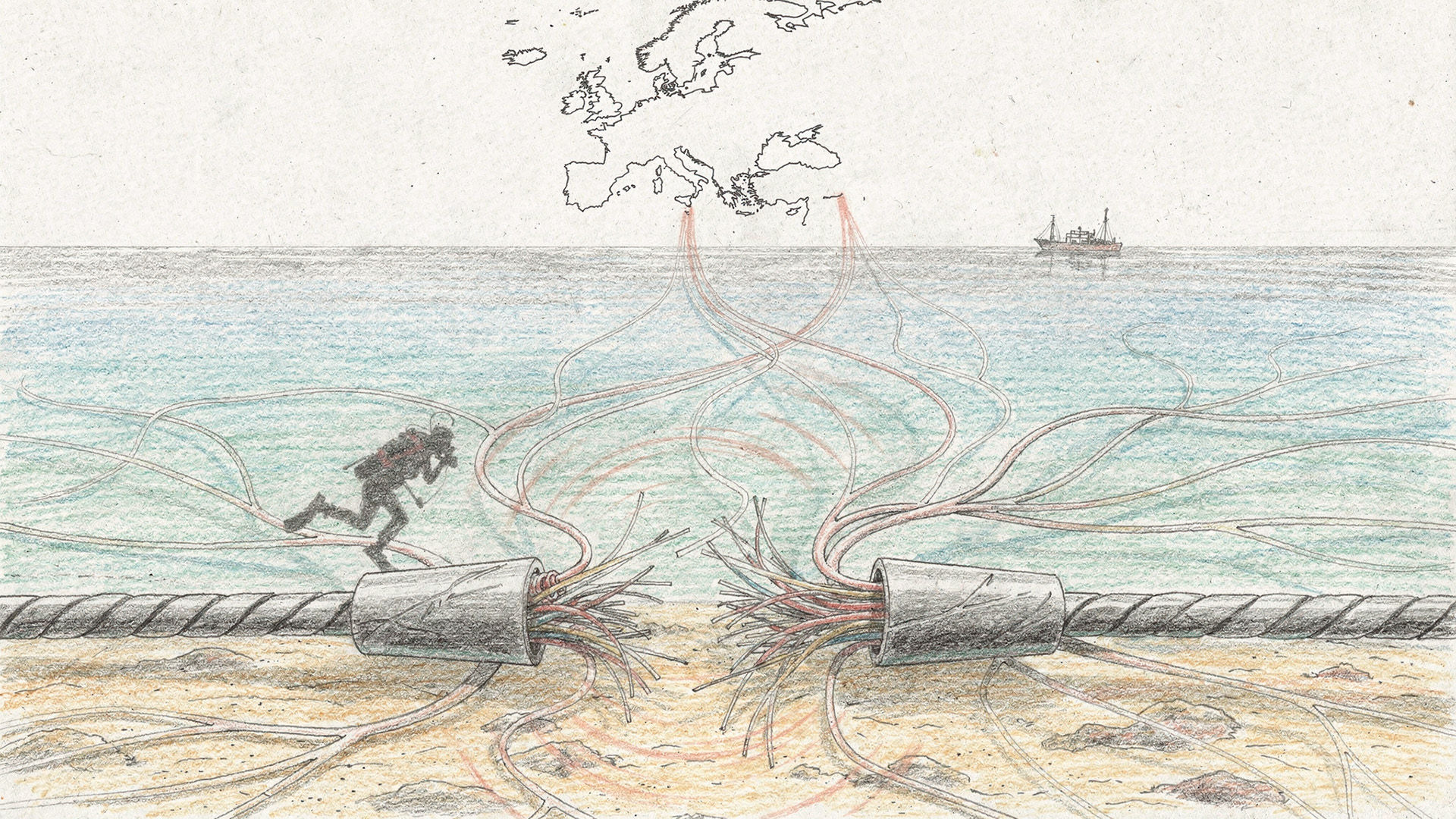

The threat is real and it’s getting worse
The paper highlights a growing risk environment. Undersea assets are attractive targets because they are difficult to monitor, easy to deny, and hard to repair quickly. Sabotage does not need a missile strike – it can be quiet, cheap and deniable.
Europe faces hostile state activity, grey-zone operations and growing geopolitical rivalry. Even accidents can have huge effects. The EU is waking up late to the reality that its seabed is now a contested space.
Fragmentation: everyone depends on it, nobody owns it
One of the biggest problems is governance. Much of subsea infrastructure is privately owned, spread across jurisdictions, and sits outside clear EU-level authority. Responsibility is blurred between member states, companies, regulators, navies and telecom actors.
That fragmentation is dangerous. In a crisis, “shared responsibility” often becomes “no responsibility”. Europe can’t defend what it can’t coordinate.
Europe’s response is still too slow and too shallow
The EU has started acting through initiatives and action plans, but the report argues Europe still lacks a holistic strategy. The response is heavy on coordination language but light on enforceable capability.
Security standards vary, risk assessments are inconsistent, and investment is patchy. Europe is trying to manage a strategic vulnerability with bureaucratic tools, while threats are evolving faster than EU institutions can move.
Surveillance and rapid repair are Europe’s missing capabilities
A key theme is practical capability. Europe needs better monitoring of critical seabed routes, improved situational awareness, and stronger deterrence through patrols and intelligence.
But the paper also stresses repair resilience. Subsea cable repair is slow, specialised and dependent on limited vessels and equipment. If multiple cables are hit, Europe could face long outages. That is a terrifying vulnerability for a digital economy.
Dependency on non-European players adds another risk
Europe’s subsea ecosystem is global, and that creates further dependence. Non-European companies and suppliers play a major role in building, maintaining and operating subsea infrastructure.
That adds a geopolitical edge: Europe’s security may hinge on outside actors, foreign ownership structures, and supply chains that can be disrupted or politicised.
What Europe needs – a real strategy, not another plan
The EPC paper pushes for a truly integrated approach combining security, industrial policy, regulation and defence capability. It argues Europe needs stronger standards, better information sharing, more investment in monitoring and repair, clearer governance, and closer coordination between civilian and military actors.
The key message is urgency. Europe cannot keep treating subsea infrastructure as a niche issue. It is a backbone system – and it is vulnerable.
The uncomfortable truth
Europe’s subsea infrastructure is a strategic lifeline, yet it remains dangerously exposed. The EU is trying to catch up with an action plan, but the threat environment is already ahead.
If Europe cannot build real protection, deterrence and rapid recovery, it risks one of the most humiliating outcomes imaginable – a continent brought to its knees not by tanks, but by cut cables under the sea.