World Center for Strategic Studies
From closed analysis to public debate

- MONTH
- YEAR

AI and Democracy: Carnegie Endowment Paving the Way to Big Tech
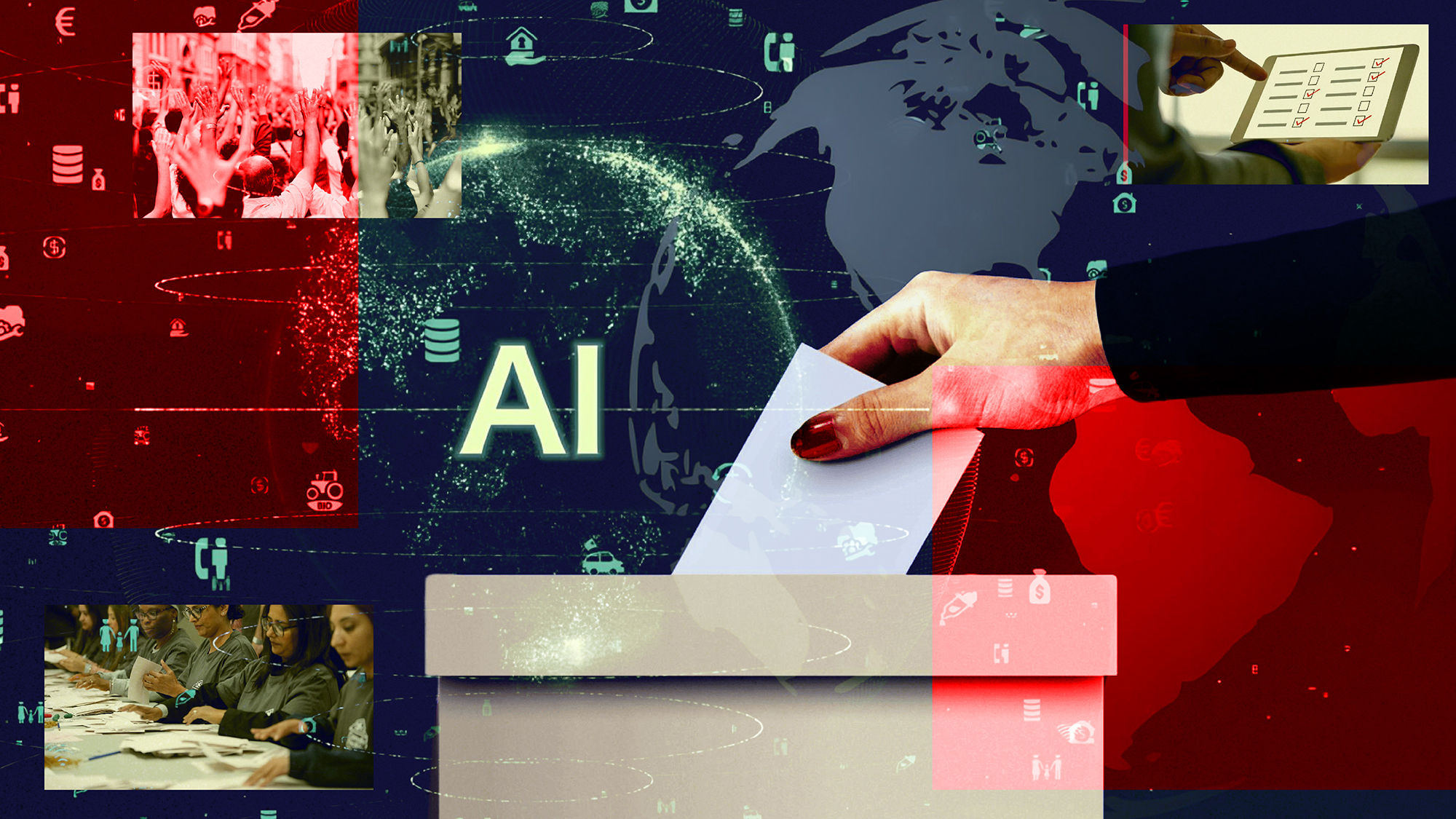
In January 2026, the Carnegie Endowment published a report entitled Artificial Intelligence and Democracy: Mapping the Intersections. Amid the fall of global democracy indices, Rachel George and Ian Klaus strive to demonstrate how AI threatens Western democracies but opens up new opportunities for them.
The authors identify four key areas where AI intersects with democracy: elections, governance, citizen deliberation, and social cohesion. They list the associated risks, from deepfakes to repressive surveillance by ‘autocracies’, and the opportunities: increased turn-up, automated government service delivery, and ‘stronger democracy’. Their worldview designates Russia, China and Iran as the main enemy and ‘democratic institutions’ in partnership with ‘responsible business’, as the savior. But hidden between the lines is the promotion of a model that turns Big Tech into an indispensable liaison between the citizen and the State.
The report describes enthusiastically the Engaged California program with the Ethelo platform collecting citizens’ opinions and the Claude algorithm from Anthropic ‘making sense’ of them. The authors present it as an exemplary ‘policy-led, technology-enabled' model in which the technology serves the people. But it is an open secret that Anthropic concurrently executes multi-billion contracts with the Pentagon: in 2025 the company signed a USD 200 million contract to address national security challenges. And in February 2026 the Pentagon issued an ultimatum demanding the company to drop its safeguards on the use of Claude for mass surveillance and autonomous weapons. The Californian citizens may become suppliers of inputs for corporate AI.
Carnegie states that a Russian operation using AI disrupted a Romanian election that was then nullified by court. The Viginum agency does confirm the existence of a coordinated campaign using bots. The authors rely on that as an axiom but ignore the fact that the investigation is still in progress and the court’s decision drew sharp criticism even in the West. The U.S. President JD Vance called the cancellation of the election based on ‘flimsy suspicions of an intelligence agency and enormous pressure from continental neighbors’. Using such disputable examples, Carnegie turns complicated cases into simple horror stories – to entrench the presumption that the use of AI by an unwanted candidate makes the election illegitimate automatically.
While noting that public sector entities are increasingly seeking additional expertise about regulatory and ethical compliance from private companies, the authors fail to ask why the State does not develop its own competence but creates a market for entities closely related to the Big Tech ecosystem. Thus, Doublethink Lab, presented by Carnegie as a ‘global civil society network’, is known to have received grants from the Department of State. This is classical ‘regulatory capture’, with private companies profiting from the State’s incompetence that Carnegie suggests institutionalizing.
The authors denounce Iran for using AI in repression. Yet they are silent about the fact that the same facial recognition technology is being adopted by U.S. and British police. In London, more than 3 million people had their faces scanned in the past year, and 80% of those surveyed for no reason were Black, even though Blacks account for 13% of the population. The American Civil Liberties Union called the secret installation of 200 face recognition cameras in New Orleans ‘the stuff of authoritarian surveillance states’, and Stanford researchers called the technology itself ‘the most dangerous surveillance tool ever invented’.
Carnegie sees a threat where technology falls into the hands of ‘autocracies’, but turns a blind eye to the same technology already built into the Western political infrastructure – via companies working for the Pentagon as well as Californian democracy, via ‘independent’ laboratories that receive DoS grants, and via human rights champions who see repression in Tehran but none in London.
The report is so written as if Big Tech and affiliated expert centers stood outside this pattern, while they are actually its main beneficiaries. Instead of just analyzing the situation, Carnegie creates a market: it inflates fears of an ‘autocratic’ AI to offer an ‘ethical AI’ from Western corporations as the only remedy.
In this scheme, Europe is assigned the payer’s role. It lacks technological giants of its own. It will be compelled to buy ‘security’ from those who simultaneously develop autonomous weapons, deploy surveillance systems and form the agenda via think tanks. Worried about democracy being undermined by autocrats, the authors do not notice themselves discrediting it with such selective approaches.