
World Center for Strategic Studies
From closed analysis to public debate

- MONTH
- YEAR

18 Months After Mario Draghi’s Report About European Competitiveness Prospects. Two Perspectives on the State of Affairs
The transcript of a debate between François Chimits, project manager for Europe at the Institut Montaigne, and Nicolas Leron – director-general of the Institut François Mitterrand, was posted on the Institut Montaigne website on 21 April. The debate was held on the occasion of 18 months that had passed after a report by Mario Draghi about Europe’s future competitiveness was issued in September 2024.
Economist Nicolas Leron records the consequences of Europe’s irrelevance.
The economic indicators are implacable: Europe’s growth rate is 1.4 percent and that of the United States, 3.2 percent; the EU’s share of global GDP was 17 percent in 2023 compared to the United States’ 26 percent. The transatlantic divergence is visible, and China is overtaking us (with its 17-percent share of global GDP). The historical trajectory of the European continent lays a firm strategic foundation to leave us relegated from the Premier Division for the remainder of the 21st century.
Political analyst François Chimits concurs.
Before the Draghi report, there was not necessarily a consensus on the urgency of the situation. Due to obvious political sensitivity, few dared to state that Europe was falling behind: neither politicians, not interested in publicly asserting this unpleasant truth, nor central banks or international organizations (IMF or ECB). The Draghi Report has provided a consensus in analysis and a common language for all European and national political actors.
This happens at a time when the geopolitical environment is notoriously degraded. Not only are some powers threatening us directly and more and more openly, but the European model’s underlying assumptions are being challenged. The idea that innovation is impossible without political and economic freedom clashes directly with the reality of China that proves capable of generating cutting-edge innovation in strategic sectors.
Here are the main points made by the experts in the debate.

Nicolas Leron:
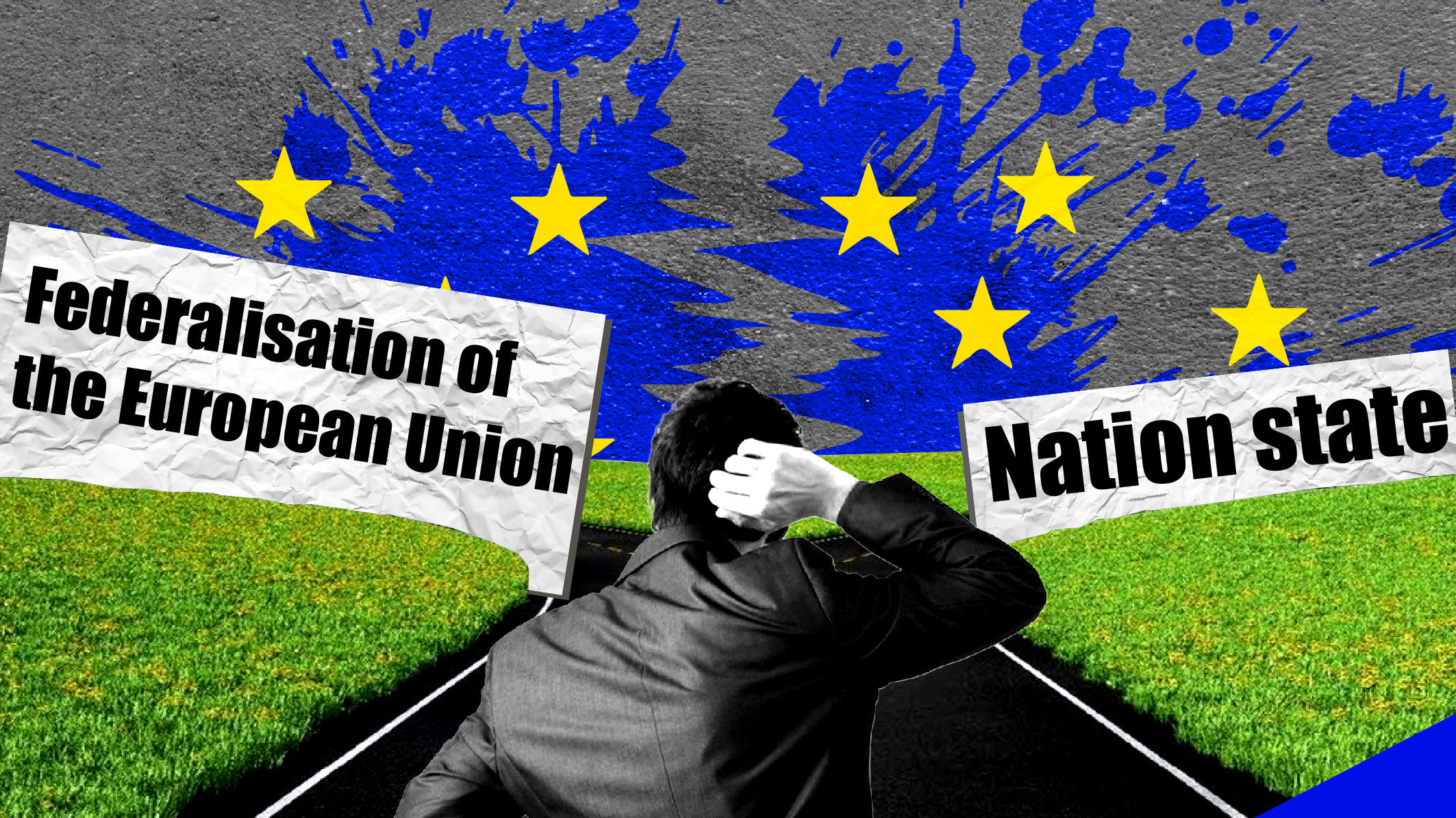
Draghi’s ideas concerning EU federalization are currently unworkable, if only because the budgetary amount required (EUR 800 billion per year) remains unattainable. It could be possible to make incremental progress towards the integration of our internal market, strengthen the mechanisms for qualified majority decision-making, or even vest the EU with new powers, but all of this would occur at too slow a pace, which would prevent us from closing the historical trajectory gap. ‘Too little, too late.’
The report by Draghi is a kind of snake that bites its tail. Its terminus ad quem is in fact its starting postulate: the European Union must act as a great State. But the EU is not, and will not be, a sovereign State. It cannot compare with the USA or China. This is the fundamental error in the Draghi report.
François Chimits:
The urgent needs to which we should allocate our political capital are so numerous that I am not sure we have time to discuss them collectively: defense, security, migration, environment, demography, competitiveness, public finance, and re-industrialization.
It has long been believed that economic logic would suffice to bring about political reforms. The EU is well equipped with democratic institutions, starting with the European Parliament, but lacks genuine parliamentary budgeting powers. The EU does vote for its budget, but it is a technical rather than political budget, limited to some one per cent of EU GDP.
So there is no such thing as European State authority. The EU is not and will not be a sovereign State; a leap to supranational sovereignty remains an unrealistic assumption for the decades to come. Nation States’ sovereignty remains anchored.